
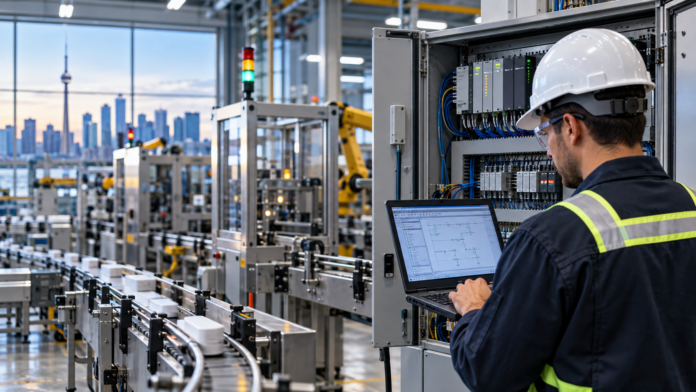

For a manufacturing plant, machine downtime is more than an equipment problem. A stopped conveyor can hold up an entire production line. A faulty sensor can interrupt a process. A PLC fault can stop several connected machines at once.
The good news is that many of these problems can be reduced with the right control strategy.
PLC Programming services can help manufacturers improve machine control, find faults faster, reduce repeated stoppages and keep production equipment running with greater consistency. PLC programming is not only about writing new control logic. It can also involve reviewing existing programs, improving machine sequences, fixing control issues, connecting equipment and upgrading older systems.
For Toronto manufacturers, this can make a major difference when production depends on automated machinery.
Why Machine Downtime Happens in Automated Manufacturing
Downtime does not always come from a major mechanical failure.
A production machine can stop because of a faulty sensor, incorrect PLC logic, communication failure, drive fault, poor sequencing or an operator issue. In some cases, the equipment itself is fine, but the control system does not respond as expected.
Common causes include:
- Faulty or unreliable sensors
- Incorrect machine sequences
- PLC program errors
- Communication problems between devices
- Drive and motor faults
- HMI alarms that do not provide enough information
- Poorly configured interlocks
- Outdated PLC hardware
- Changes made to equipment without updating the control program
- Difficult to diagnose intermittent faults
The challenge becomes greater when several machines work together.
A conveyor may depend on a sensor. The sensor may send information to a PLC. The PLC may control a motor or drive. The HMI may display the machine status to the operator.
A fault in one part of that chain can affect the whole operation.
This is where well planned PLC programming support can help.
How PLC Programming Can Help Reduce Downtime
A PLC controls the sequence and behaviour of many types of industrial equipment. It can monitor inputs, process control logic and activate outputs based on the conditions of the machine.
Good PLC programming can make that process easier to monitor and diagnose.
Instead of simply stopping when something goes wrong, a properly designed control system can provide useful information about what caused the stop.
For example, a conveyor system may stop because a product detection sensor does not provide the expected signal. The PLC can monitor that condition and trigger a specific alarm.
An operator can then see that the problem relates to the sensor rather than spending time checking unrelated equipment.
That small improvement can reduce the time needed to find and correct a fault.
- Better Machine Sequencing
Machine sequences play an important role in production reliability.
A production system may need to follow a specific order:
- Check that safety conditions are met.
- Confirm that the required equipment is ready.
- Start the first machine.
- Confirm that the machine has reached the required state.
- Start the next operation.
- Continue the sequence until the production cycle is complete.
If the sequence is not programmed correctly, equipment may stop at the wrong point or fail to restart after a fault.
PLC programming can help manufacturers review these sequences and improve the way machines respond to different operating conditions.
The goal is not simply to make the machine run. The control logic should also make faults easier to identify and recover from.
- Clearer Alarms Help Operators React Faster
An alarm that says “Machine Fault” does not tell an operator much.
A useful alarm can provide more information.
For example:
General alarm:
Machine fault.
Useful alarm:
Conveyor motor stopped because downstream photoelectric sensor did not detect product within the expected cycle time.
The second message gives the operator a starting point.
PLC programming and HMI development can work together to provide clearer information about machine conditions, alarms, process status and faults.
This can reduce the time between a machine stopping and the operator identifying the cause.
- Better Interlocks Can Prevent Unnecessary Stops
Interlocks help prevent equipment from operating when certain conditions are not safe or suitable.
For example, a machine may need to confirm that:
- A guard is closed
- A motor is ready
- A downstream conveyor is available
- A pressure level is within range
- A sensor has detected the required position
- Another machine has completed its cycle
Poorly designed interlocks can create confusing stoppages.
A properly structured PLC program can make these conditions clearer and help the control system respond in a predictable way.
This matters in production environments where operators need to know why a machine has stopped and what needs to happen before it can run again.
- Faster Troubleshooting Through Better PLC Logic
When a machine stops, every minute matters.
A technician may need to inspect the electrical panel, sensors, motors, drives, communication networks and PLC program before finding the cause.
Good PLC programming can reduce this diagnostic work by making machine conditions easier to trace.
A well structured program can include:
- Clear operating states
- Defined fault conditions
- Useful alarm messages
- Logical interlocks
- Input and output status
- Equipment feedback
- Sequence information
- Diagnostic functions
This does not remove the need for skilled troubleshooting. It gives technicians better information to work with.
That can help reduce repeated trial and error during a production stoppage.
- Connecting PLCs With HMIs and Other Equipment
Modern manufacturing equipment rarely operates as one isolated machine.
A PLC may need to communicate with:
- HMIs
- Variable frequency drives
- Servo systems
- Sensors
- Robotics
- SCADA systems
- Remote I/O
- Industrial networks
- Other PLCs
- Production equipment
When communication between these systems is unreliable, production can suffer.
PLC programming can include the development and modification of control logic that allows different parts of an automated system to work together.
Better integration can help reduce communication related faults and give operators better visibility into equipment status.
- Improving Older PLC Systems
Many Toronto manufacturing facilities operate equipment that has been in service for years.
Replacing an entire machine is not always necessary.
An existing control system may still be useful but have problems such as:
- Outdated PLC hardware
- Difficult to maintain programs
- Missing documentation
- Old HMI screens
- Unreliable communication
- Limited diagnostic information
- Components that are becoming difficult to source
A PLC review can help determine which parts of the system need attention.
In some cases, the right solution may involve modifying the existing program. In other cases, a phased control system upgrade may make more sense.
The key is to improve reliability without creating unnecessary disruption to production.
- Reducing Downtime During Equipment Changes
Manufacturing equipment changes over time.
A company may add a new conveyor, replace a motor, install a new sensor or change a production sequence.
The PLC program may also need to change.
If the control logic does not match the updated equipment, unexpected faults can occur.
Before making changes, the existing PLC program, hardware, I/O, communication paths and machine sequence should be reviewed.
This helps reduce the risk of introducing a new problem while trying to solve an old one.
- Using PLC Programming to Support Preventive Maintenance
PLC data can also provide useful information about equipment behaviour.
For example, a control system may track:
- Machine cycles
- Motor running time
- Fault frequency
- Equipment status
- Alarm history
- Production counts
- Process conditions
This information can help maintenance teams spot recurring problems.
If a particular motor fault appears several times each week, that pattern deserves attention.
Instead of waiting for the machine to fail completely, the maintenance team can investigate the underlying problem.
PLC programming can therefore support a broader maintenance strategy rather than only being used after a machine stops.
Where PLC Programming Can Make the Biggest Difference
Different manufacturing environments have different control requirements.
In Toronto and the surrounding GTA, automated equipment can include production machinery, packaging systems, conveyors, processing equipment, material handling systems and other industrial machines.
The PLC application needs to match the equipment and process.
Production Lines
Production lines depend on correct machine sequencing and communication between different pieces of equipment.
A PLC can coordinate these operations and manage faults when one part of the line stops.
Packaging Equipment
Packaging machinery often relies on sensors, motors, drives and precise sequences.
Good PLC logic can help coordinate these functions and provide useful fault information when production stops.
Conveyor Systems
Conveyor systems can involve multiple motors, sensors and control points.
PLC programming can help coordinate the movement of materials and prevent one fault from creating confusion across the entire line.
Processing Equipment
Process equipment may involve pumps, valves, sensors and controlled operating conditions.
PLC logic can monitor these conditions and respond when the process moves outside the required range.
Automated Machinery
Custom machinery often requires PLC logic built around a specific operating sequence.
The control program must reflect the actual machine design, operator requirements and production process.
A Practical Approach to Reducing Machine Downtime
Reducing downtime starts with finding the real cause of the problem.
A useful PLC programming project can follow a clear process.
Step 1: Review the Existing System
Start with the PLC program, hardware, HMI, I/O and communication structure.
The goal is to identify how the system currently operates.
Step 2: Identify Recurring Faults
Look at the faults that cause the most production interruptions.
A machine that stops once a year may not need the same attention as one that stops several times each week.
Step 3: Review the Control Logic
Check sequences, interlocks, alarms, timers, inputs and outputs.
Look for areas that can create unexpected stops or make troubleshooting difficult.
Step 4: Improve Diagnostics
Add useful alarm messages and diagnostic information where required.
Operators and technicians should be able to see what the system is waiting for or why it has stopped.
Step 5: Test the Changes
PLC modifications should be tested before they are placed into normal production use.
Testing can include sequence checks, I/O checks, alarm testing and machine operation under suitable conditions.
Step 6: Document the Changes
Updated documentation helps the maintenance team support the system later.
It also makes future PLC modifications easier.
Why Local PLC Support Matters for Toronto Manufacturers
When a production machine stops, the problem is not limited to software.
A technician may need to look at the PLC, control panel, wiring, sensors, drives, HMI and connected machinery.
Local PLC Programming Toronto support can make it easier to connect programming work with the physical equipment on the plant floor.
ControlSoft Canada provides PLC programming, HMI development, system integration, troubleshooting and control system upgrade support for industrial applications. The company’s Toronto service page also presents support across the Toronto GTA area, including programming, troubleshooting, control system work and automation support.
The important point is that PLC programming should be connected to the actual machine and production process.
PLC Programming Is About More Than Writing Code
A PLC program can work correctly and still be difficult to maintain.
For a manufacturing facility, the better goal is a control system that is:
- Reliable
- Easy to diagnose
- Clear for operators
- Easier for technicians to maintain
- Properly documented
- Able to communicate with connected equipment
- Suitable for the production process
ControlSoft Canada’s PLC service approach includes existing PLC evaluation, program development and modification, hardware evaluation, performance recommendations, obsolescence planning, industrial communication support and testing support.
That wider view matters when the real business goal is to reduce downtime.
When Should a Toronto Manufacturer Review Its PLC Program?
A PLC review may be worth considering when:
- The same machine fault happens again and again
- Operators cannot tell why equipment has stopped
- Technicians spend too long finding faults
- Production sequences have become difficult to manage
- New equipment has been added to an older machine
- The PLC or HMI is becoming obsolete
- Machine documentation is incomplete
- Communication faults occur between control devices
- The existing program has been modified many times over the years
- Downtime is increasing without a clear mechanical cause
A review does not always mean replacing the complete control system.
Sometimes a focused PLC modification can solve the problem. Other projects may need HMI changes, communication improvements, hardware replacement or a larger control system upgrade.
Reduce Downtime with Better Control
Machine downtime can come from many sources, but the control system has a major role in how quickly a problem is detected, diagnosed and corrected.
Better PLC logic can improve machine sequencing. Better alarms can help operators identify faults. Better communication can improve coordination between equipment. Better diagnostics can help technicians find problems faster.
For Toronto manufacturers, PLC Programming Toronto can therefore be part of a practical strategy to improve equipment reliability and reduce production interruptions.
If your machines are experiencing repeated faults, unexplained stops or difficult troubleshooting issues, reviewing the existing PLC program can be a useful first step.
ControlSoft Canada supports PLC programming, HMI development, system integration, troubleshooting and control system upgrades for industrial applications across Toronto and the GTA. The company’s existing service content also highlights support for automated machinery, production equipment, conveyors, processing systems and packaging equipment.
Need Help with PLC Programming in Toronto?
If machine downtime is affecting production, start with the control system that manages the equipment.
Connect with ControlSoft Canada about your PLC programming requirements and find out where your existing control system can be improved.

